
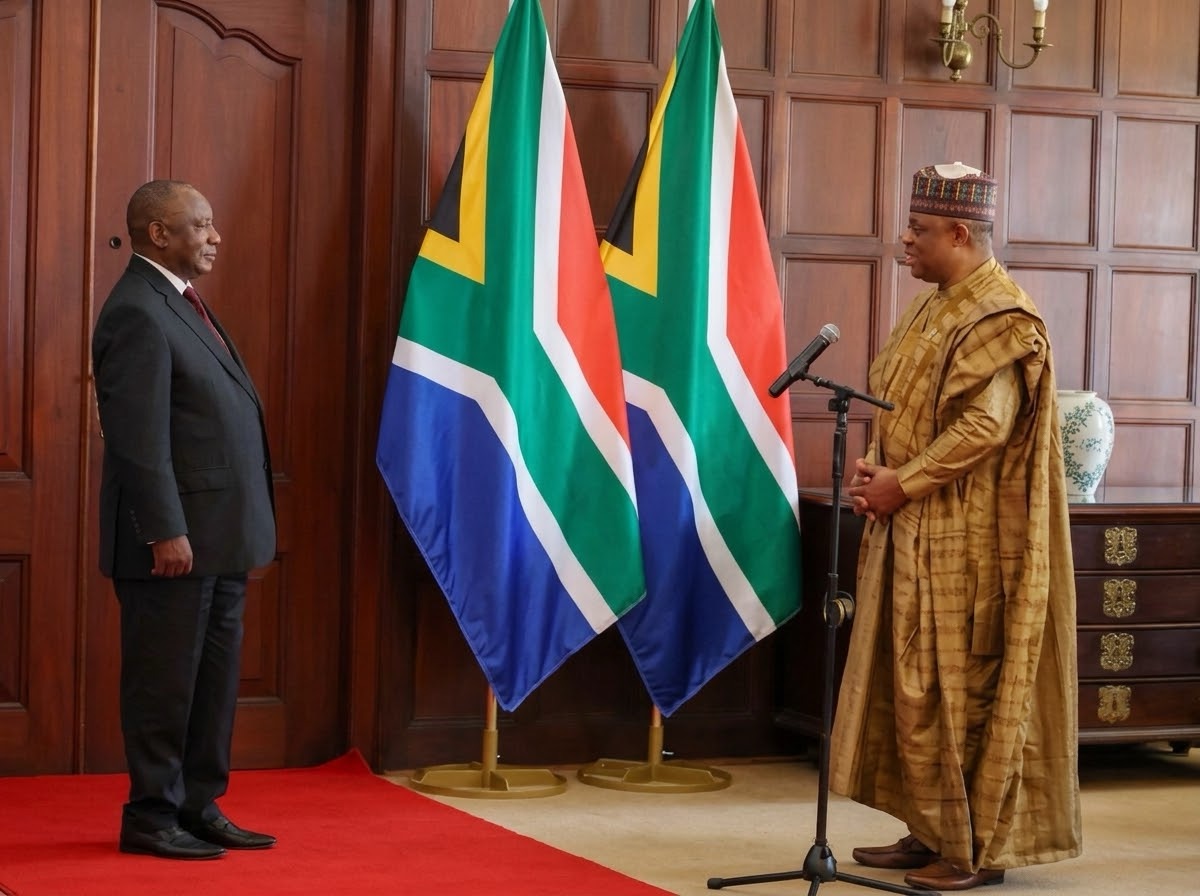
18 November 2026 | Politics and Diplomacy
Nigeria’s newly appointed High Commissioner to South Africa, Olufemi Adewumi Fani-Kayode, has found himself at the centre of a diplomatic controversy barely days after formally presenting his credentials to President Cyril Ramaphosa. The former Nigerian minister’s public confrontation with South African officials has prompted questions about his approach to diplomacy, particularly given his previous clashes with journalists and a lengthy history of legal battles involving Nigeria’s Economic and Financial Crimes Commission (EFCC).
The latest dispute followed the diplomatic credentials ceremony held in Pretoria on Friday, 13 November. Fani-Kayode alleged that Nigeria was the only delegation whose introduction and address were excluded from the livestream of the event. He claimed that the omission was deliberate and suggested that elements within South Africa did not want Nigeria’s representatives to be heard or seen. He also said he raised the matter directly with Ramaphosa, who directed him to the relevant officials.
However, the Presidency disputed aspects of the envoy’s account. Presidential spokesperson Vincent Magwenya said Ramaphosa had not intervened in the operations of the broadcaster and had simply directed Fani-Kayode to SABC’s acting political and foreign editor, Sophie Mokoena, to raise his concerns. Magwenya criticised the envoy for taking the matter to social media rather than engaging through the appropriate channels, describing his approach as “grossly inappropriate”. The Presidency subsequently released a recording of the ceremony that included Fani-Kayode’s speech.
The dispute escalated further when the Nigerian High Commission defended its representative and criticised the response from the South African Presidency. The SABC also issued a clarification, emphasising that its editorial coverage was independent of the Presidency’s livestream arrangements. Fani-Kayode had declined an interview with SABC News, reportedly because of his dissatisfaction with the way the ceremony had been handled.
The matter eventually reached DIRCO. On Tuesday, 17 November, Director-General Zane Dangor met Fani-Kayode to convey South Africa’s concerns about the events surrounding the credentials ceremony and the envoy’s subsequent social media remarks. DIRCO specifically reminded him of Article 41 of the Vienna Convention on Diplomatic Relations, which requires diplomatic agents to conduct official business with the receiving state through its foreign ministry. In South Africa’s case, that means using established diplomatic channels, including DIRCO.
The intervention is significant because Fani-Kayode had arrived in South Africa presenting himself as a representative seeking to rebuild relations between the two countries. He arrived on 25 October and formally began his diplomatic duties on 30 October. His appointment comes at a sensitive time, with relations between Pretoria and Abuja already under pressure over xenophobic attacks, the safety of Nigerian nationals and disagreements about the treatment of foreign nationals in South Africa.
A previous confrontation with a journalist
The latest incident has also revived memories of a widely publicised confrontation between Fani-Kayode and Daily Trust journalist Eyo Charles in August 2020.
During a press conference in Calabar, Charles asked who was financing Fani-Kayode’s tour of several states. The former minister reacted angrily, challenged the journalist over the question and called him “stupid” in front of cameras. The exchange was recorded and circulated widely, attracting criticism from journalists and media organisations.
The Cross River State chapter of the Nigerian Union of Journalists responded by blacklisting Fani-Kayode and called on media houses to withdraw their correspondents from government events involving him. The incident became a major press-freedom controversy in Nigeria.
Fani-Kayode later issued an apology, saying he withdrew the word “stupid” and regretted losing his temper. He denied threatening the journalist with physical harm. His apology is part of the public record, but the incident remains relevant when examining the concerns raised about his handling of disagreement with members of the media.
The corruption investigations and court outcomes
Fani-Kayode’s political career has also been marked by a number of high-profile cases involving the EFCC. These cases deserve scrutiny, but it is essential to distinguish the allegations made by prosecutors from what courts ultimately decided.
In one case dating back to 2008, the EFCC accused him of money laundering involving approximately ₦100 million allegedly received while he served as Nigeria’s Minister of Culture and Tourism and later Minister of Aviation. In November 2014, a Federal High Court dismissed 38 of the 40 counts, finding that the prosecution had not established those allegations beyond reasonable doubt. On 1 July 2015, the court discharged and acquitted him on the remaining counts.
A separate prosecution involved allegations relating to approximately ₦4.6 billion in funds associated with the 2015 presidential campaign of former President Goodluck Jonathan. Fani-Kayode was charged alongside former Finance Minister Nenadi Usman, Yusuf Danjuma and a company. The EFCC alleged unlawful retention and use of funds, as well as cash transactions that allegedly breached money-laundering legislation. In April 2023, the Court of Appeal quashed the charges. The allegations should therefore not be reported as proven corruption.
In another matter, Fani-Kayode faced a three-count EFCC prosecution involving alleged money laundering and funds linked to former National Security Adviser Sambo Dasuki. On 15 January 2025, a Federal High Court in Abuja discharged him after finding that the prosecution had failed to provide sufficient evidence linking him to the alleged offences.
He was also charged in a separate 12-count case involving allegations that false medical reports had been procured and used in an attempt to secure adjournments in another criminal trial. Fani-Kayode denied the allegations. On 4 February 2025, the Lagos State Special Offences Court discharged and acquitted him, ruling that the prosecution had failed to establish a prima facie case linking him to the alleged offences.
These legal outcomes are important. They establish that Fani-Kayode has faced repeated and serious investigations and prosecutions, but they do not establish that he was convicted of the corruption or forgery allegations. He has consistently denied wrongdoing, and the courts ruled in his favour in the cases described above.
Questions about diplomatic conduct
Fani-Kayode is not an inexperienced political figure. He has served as a minister, worked in presidential political circles and built a reputation as an outspoken commentator in Nigerian politics. His supporters may regard his willingness to challenge South African officials as a defence of Nigerian citizens and national dignity, particularly amid concerns about xenophobic violence.
But diplomatic representation requires more than forceful public statements. It also requires restraint, respect for official channels and the ability to manage disagreements without allowing them to become public confrontations.
The question now facing Pretoria and Abuja is whether Fani-Kayode can balance his outspoken political style with the responsibilities of representing Nigeria in a country with which it has a complex and strategically important relationship.
His first weeks in South Africa have already produced a public disagreement with the Presidency, a response from the SABC and a formal intervention by DIRCO. Whether this becomes an isolated incident or a pattern that complicates diplomatic relations remains to be seen.
For South Africans, the issue is not whether Nigeria should defend its citizens. It should. The question is whether the country’s new representative can do so while respecting the institutions and diplomatic processes of the host nation.


Leave a Reply