
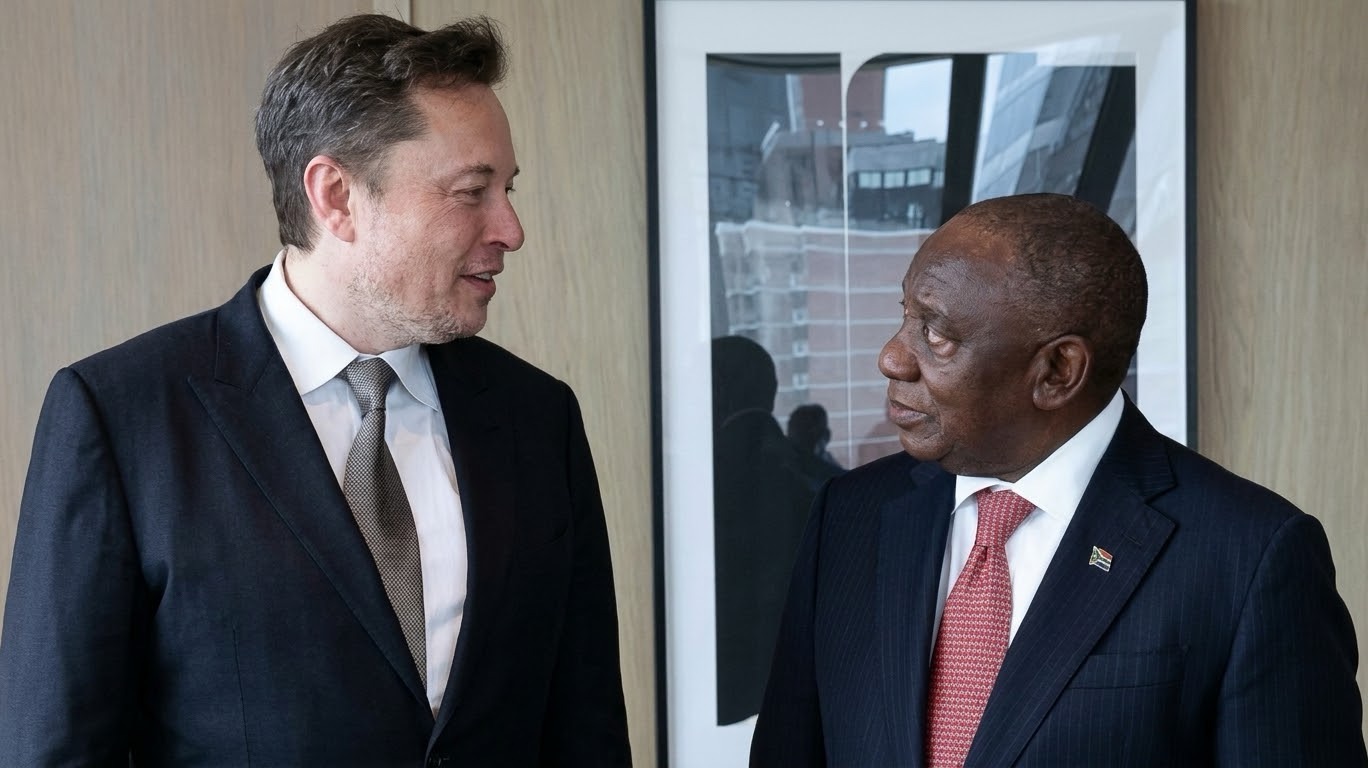
Elon Musk has accused South Africa of being “super racist against Whites and Asians” following President Cyril Ramaphosa’s appeal for the billionaire to remember his South African roots and contribute to the country’s development. The public exchange has reignited the debate over Black Economic Empowerment (B-BBEE), historical redress and the regulatory battle surrounding Musk’s satellite internet company, Starlink.
Musk made the remark on X on Tuesday, 17 November 2026, responding to a post featuring Ramaphosa’s interview with ABC News correspondent Jonathan Karl at the Semafor: Silicon Valley & The World event in California a day earlier. The president was in the United States leading a South African delegation seeking investment and partnerships in technology and artificial intelligence.
During the interview, Ramaphosa said he had previously met Musk and admired his achievements, but wanted to encourage him to contribute to the country where he grew up. The president argued that the opportunities Musk received through his education in South Africa were shaped by an apartheid-era system that provided substantially better resources to white learners than to black learners.
Ramaphosa illustrated the inequality by comparing government education spending during apartheid, saying: “When the apartheid government spent R12 on his education, it spent R1 on my education.” He argued that understanding this historical imbalance was important when considering policies designed to address the inequalities that remain in South African society.
Musk’s response was direct: “South Africa is now super racist against Whites and Asians.” His statement is an accusation and does not, by itself, establish that South Africa’s laws or institutions discriminate against those groups. It reflects his longstanding criticism of the country’s transformation policies, particularly those requiring businesses to meet empowerment and ownership requirements.
At the centre of the disagreement is Starlink, the satellite internet service operated by Musk’s SpaceX. The company has not obtained the individual telecommunications licences required to provide its services directly to South African customers. Under the current regulatory framework, individual licence holders are subject to a requirement for at least 30% ownership by historically disadvantaged groups. SpaceX has challenged this requirement, arguing for an alternative arrangement that would allow it to contribute through investment programmes rather than transferring local ownership.
Communications Minister Solly Malatsi has supported exploring an alternative through Equity Equivalent Investment Programmes (EEIPs). These arrangements would allow qualifying multinational companies to contribute towards economic transformation through initiatives such as skills development, enterprise support and investment, rather than necessarily transferring shares in their local operations.
Starlink has previously proposed a R500 million investment to connect 5,000 predominantly rural schools to free high-speed internet, potentially benefiting more than 2.4 million learners annually. However, the proposal has not resulted in the company receiving approval to launch commercially in South Africa. ICASA has maintained that the existing legislation requires the ownership threshold and that fully aligning its regulations with alternative investment arrangements would require legislative changes.
The dispute has now moved into the courts. Business organisation Sakeliga filed an application in the Pretoria High Court in November challenging ICASA’s position on the ownership requirement and its decision not to fully implement the communications minister’s policy direction. The organisation argues that the law allows alternative empowerment arrangements to be considered. The application has not yet been decided, and it does not automatically grant Starlink permission to operate in South Africa.
Ramaphosa, meanwhile, has maintained that international companies seeking to operate in South Africa must comply with the country’s laws and policies, just as businesses must follow the regulations of other countries in which they operate.
The latest exchange therefore brings two competing arguments back into the spotlight: the government’s position that transformation policies are necessary to address the lasting economic effects of apartheid, and Musk’s criticism that race-based requirements unfairly restrict certain businesses and individuals.
For now, there is no confirmed Starlink launch date in South Africa, and the legal and regulatory dispute remains unresolved.



Leave a Reply