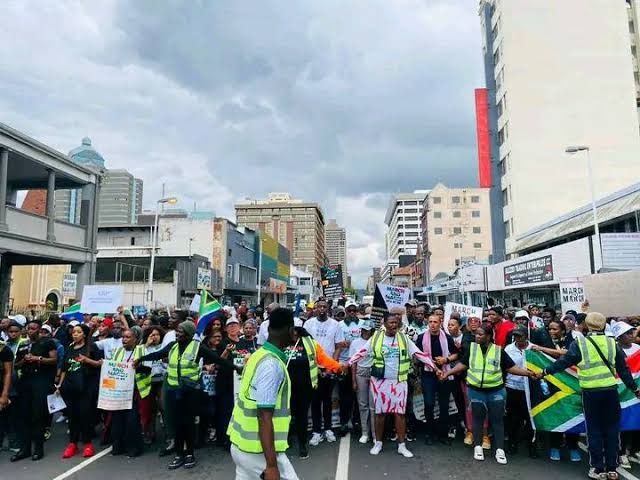
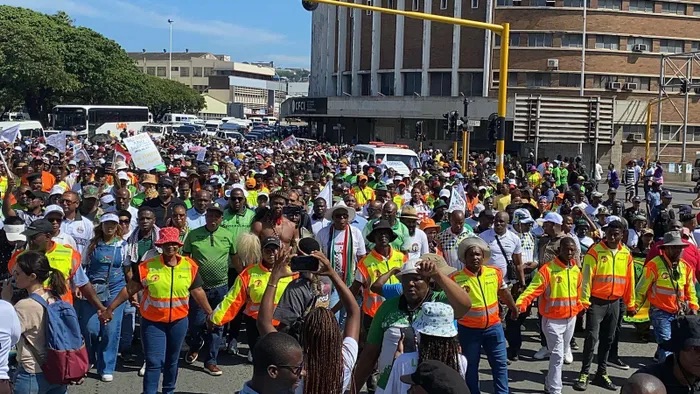
Thousands of demonstrators filled the streets of Durban this week as members of the March and March Movement staged a major protest demanding stricter action against illegal immigration and stronger enforcement of South Africa’s immigration laws.
The demonstration, held in the Durban central business district, has drawn national attention due to its size, political involvement, and the tense confrontations that followed.
What Sparked the March and March Protests
The protests were organised by the March and March Movement, a civic group founded in 2025 to campaign against illegal immigration and what it describes as government failures to address crime, unemployment, and drug trafficking.
According to organisers, the march aimed to highlight what they called “persistent shortcomings in immigration enforcement, border control, and regulatory oversight.”
Thousands of protesters gathered at King DinuZulu Park before marching through the city centre, carrying placards and chanting slogans calling for mass deportations and stronger border security.
The protest also received support from members of political organisations and civic groups who joined the demonstration to amplify demands for government intervention.

Police Clashes and Crowd Control Measures
As the march progressed, tensions escalated between protesters and law enforcement officials.
Police deployed rubber bullets and tear gas to disperse sections of the crowd after demonstrations became confrontational in parts of Durban.
Authorities reported that crowd-control measures were used to prevent damage to property and maintain order in the city centre.
Security officials monitored the situation closely due to concerns that similar protests in the past have sometimes turned violent.
Political and Community Involvement
The protest saw participation from members of several political parties and activist groups, highlighting the growing political significance of the issue.
Groups involved included supporters from organisations advocating for tighter immigration laws and increased law enforcement against undocumented foreign nationals.
Observers note that immigration has become a highly sensitive topic in South Africa, particularly amid:
High unemployment rates Rising crime concerns Pressure on public services Economic hardship affecting local communities
These factors have contributed to growing frustration among sections of the public, leading to repeated demonstrations across several provinces.
A Movement That Continues to Grow
The March and March Movement has expanded rapidly since its formation.
What began as a single protest has evolved into an organised national campaign targeting issues such as:
Illegal immigration Drug trafficking Allegations of corruption within law enforcement Access to public services by undocumented migrants
In previous months, members of the movement also staged protests against drug activity in parts of Durban, accusing criminal networks of operating openly in certain areas.
Public Safety Concerns and Xenophobia Fears
While supporters argue that the protests are about law enforcement and national security, critics have raised concerns that such demonstrations risk fueling xenophobic tensions.
South Africa has experienced waves of anti-foreigner violence in the past, sometimes resulting in injuries, deaths, and destruction of businesses.
Experts warn that if protests escalate into violence, the consequences could include:
Increased attacks on foreign-owned businesses Heightened community tensions Damage to the country’s international reputation Strain on policing resources
Authorities have urged demonstrators to remain peaceful and comply with legal protest regulations.
Government Response and Future Plans
Government officials have acknowledged public concerns around immigration enforcement but have also emphasized the need to protect constitutional rights and maintain public order.
Organisers of the March and March Movement have stated that further protests may be planned if their demands are not addressed.
Security analysts believe that the movement’s continued mobilisation could lead to:
More nationwide demonstrations Possible parliamentary debates Increased policing operations Greater focus on border control enforcement
Crime Connect News Analysis
The March and March protests represent one of the most visible public demonstrations in recent months regarding immigration and crime concerns in South Africa.
While the protests remain controversial, they reflect growing frustration among communities that believe stronger action is needed against criminal activity and illegal immigration.
However, experts warn that continued protests without structured government engagement may increase tensions, especially if demonstrations turn violent or target vulnerable communities.
The situation remains fluid, and further developments are expected as authorities monitor the movement and respond to its demands.
 Crime Connect News
Leave a comment